
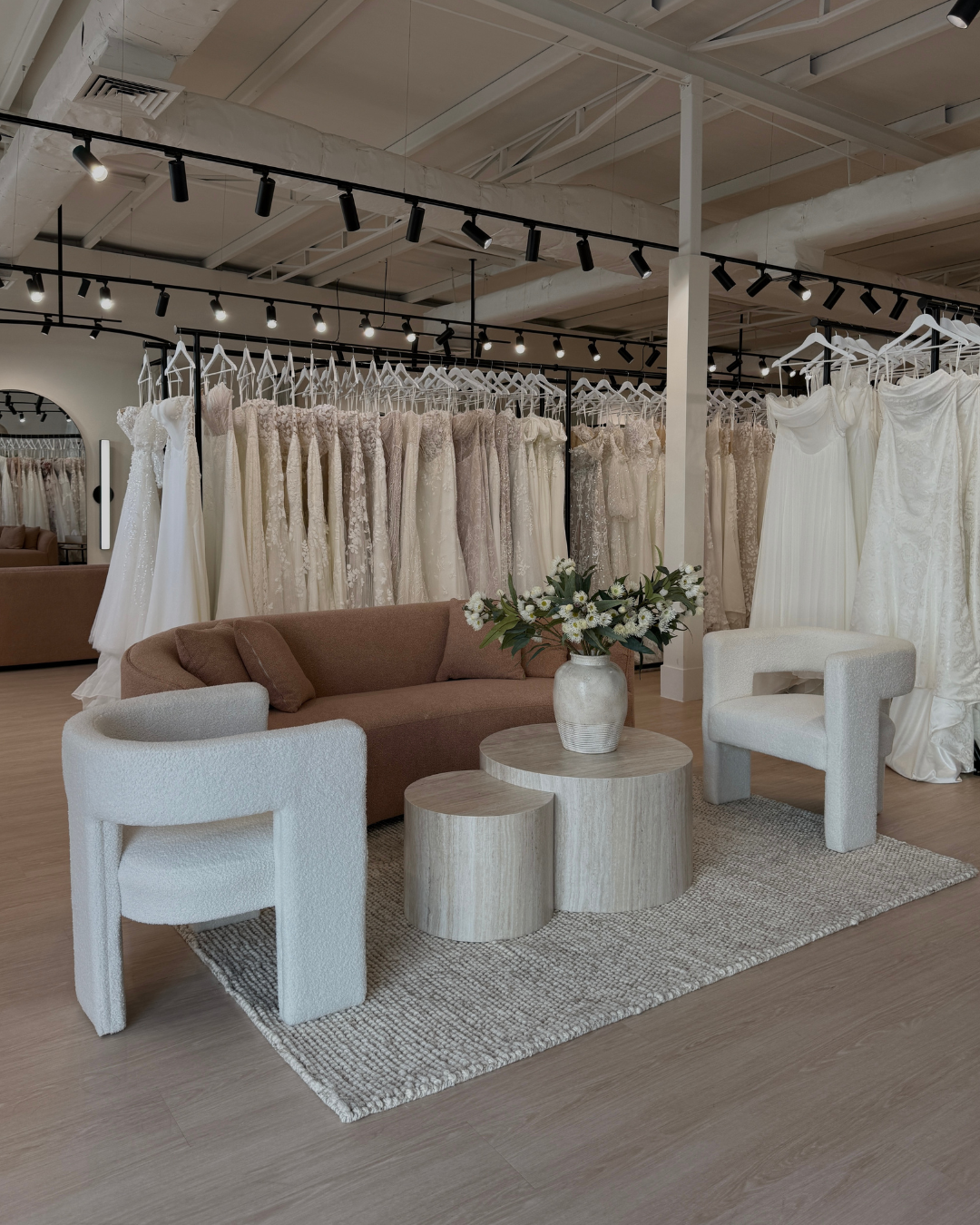
Sydney, New South Wales
Luv Bridal is Australia’s largest bridal chain and has been trading since 2009, with twelve showrooms from Townsville to Hobart.
Bridal Dress Stores
Visit in person
The Journal · Booking timeline
Every other supplier is asking whether your date is free. The dress is asking whether it can be made in time.
By The Little Wedding Planner Editors · · Updated 10 September 2026
A wedding gown is not booked, it is built, and the calendar it is built on belongs to the designer rather than to the shop you are standing in. The clock starts when you pay rather than when you fall in love, it may or may not have the fittings inside it, and money buys a few weeks of it back and then buys nothing at all. Ask for the last date you could safely order, and write it down.
You downloaded a wedding planning timeline at some point, the way everybody does, and somewhere in the middle of it there is a line that says: buy the dress.
It sits between book the celebrant and think about favours, as though it were one afternoon with your mum and a glass of something. It is the only thing in your whole wedding that has to be made, and the people who will make it have never heard of your date.
The gown on the hanger in a bridal shop is a sample. You try it on, you order it, and only then is one cut for you, usually a long way from the room you are standing in and often in another country. Some shops do sew upstairs. Most are passing your order along.
So the wait is not the shop's to set. The design house sets it, and different houses set different ones. Some shops publish a wait against every label they carry rather than one number for the whole floor, and that is the more useful thing to be handed. The honest answer to how long does a dress take is not a number. It is a question back: which one?

A bridal appointment goes in an order, and the order works against you. You work along the rail, you cry a bit, and you fall in love with the one at the end. Only then does anybody mention that this one takes longer than the others, and by then you are not really choosing.
So ask the wait on every gown you like, while you can still hear the answer. Not on the one you loved. By then the answer cannot help you choose.
The gown gets made, and then it gets fitted, and shops do not agree about whether the fittings are part of the wait.
Some quote the making and count the fittings after it. Others fold them in.
The two answers come out miles apart and neither shop has done anything wrong. The one that talks you through all of it ends up quoting the bigger number, which is a poor reward for being straight with you.
You cannot tell by looking which kind you have been handed. So say the boring sentence: does that include alterations?
Then ask the other half. When does the clock start? Not the day you walk in. It starts when you order and pay, so the weeks you spent thinking it over, and the fortnight you waited for your sister to be free, were never part of the wait.
So the deposit comes earlier than most people plan for, and it is not a token. That is not a shop being grabby. It is cloth, and a place in the queue at the workroom that will cut it, both paid for long before you carry anything home. Ask what the deposit is, then ask how it can be paid. Layby and monthly payments are worth asking about, and nobody offers you a plan you did not raise.
Here is where the gown stops behaving like anything else you are buying.
You can pay to move up the queue, and some shops publish the whole ladder: a standard wait, a quicker one for a fee, a quicker one still for more. Look hard at what that money buys. It buys weeks. It does not buy months. And the quickest step can come attached to a shorter list of gowns rather than the whole floor. A shop that tells you which ones it will not hurry is doing you a better turn than one that promises everything.
Not every shop will promise a rush at all. Sometimes, they say. It depends. That hedge is the honest half of the offer, and my reading of it is that a workroom saying no is not slow, it is full. The fee is not a fine for being late. It is the price of a place further up a queue, and the queue only moves so far. Past that, the answer is not money. It is a different dress.
Buying off the rack gets treated as a defeat.
If your timeline is short, you can buy a gown off the rack and walk out with it that afternoon. Shops say so plainly, and some keep a rail for exactly this. No factory, no delivery date to wait on, no email in January asking whether there is any news. You will still need alterations and should budget for them. But you have taken the longest and least controllable line out of your planning altogether. The size on the rack is the one that matters in that room.

One more thing, and it catches people who did everything else right. A veil is not an accessory to the dress. It is a second order, with its own maker and its own delivery date.
Nobody puts a veil on a timeline. It is what you choose at a late appointment while somebody is pinning your hem, and it gets four minutes of thought, because everyone is tired and it is only a veil. Then the gown you ordered early and the veil you ordered at the last fitting are racing for the same weekend, and the veil is the one nobody is watching. Ask at the first appointment, in the same breath as the dress.
One question does the work of all the others, and you ask it of the room rather than of a gown, so nobody has to give you bad news about the one you love. What is the last date I could order a dress here and still be safe?
Write the answer down. Not as a note. As a date, on the calendar, beside the venue deposit. It is a real deadline with a real consequence, and the only one in your whole wedding that nobody can fix at the last minute by working harder.
The line on the timeline said buy the dress. It should say order the dress, because order is the verb with a workroom on the other end of it. Everything else on that document is a booking. This one has to be made.
Luv Bridal is Australia’s largest bridal chain and has been trading since 2009, with twelve showrooms from Townsville to Hobart.
Bloom is a contemporary luxury bridal studio in Newstead, a few minutes from Brisbane’s CBD, founded in 2020 by Samantha Burgess.
Brides of Brisbane sits on Vulture Street in West End, the inner-city pocket that suits it - unhurried, a bit alternative, no marble.

Sphere Bridal Gallery is a luxury destination boutique on James Street in Fortitude Valley — one room, by appointment only, one bride at a time.
The Bridehouse Bulimba is a designer-owned bridal atelier on Oxford Street, the cafe strip that runs through Brisbane’s riverside Bulimba. It is not a stockist.
Angelic Bridal sits on Gympie Road at Chermside, an eight-minute walk from Chermside shopping centre on Brisbane’s northside.
After Five has been part of Queensland’s bridal story for over four decades. It once ran three shops; today it is deliberately one, a single boutique on Kingston…
White Lily Couture is a large multi-brand boutique at Red Hill, a few minutes from Brisbane’s CBD.